Dynamic reconfiguration
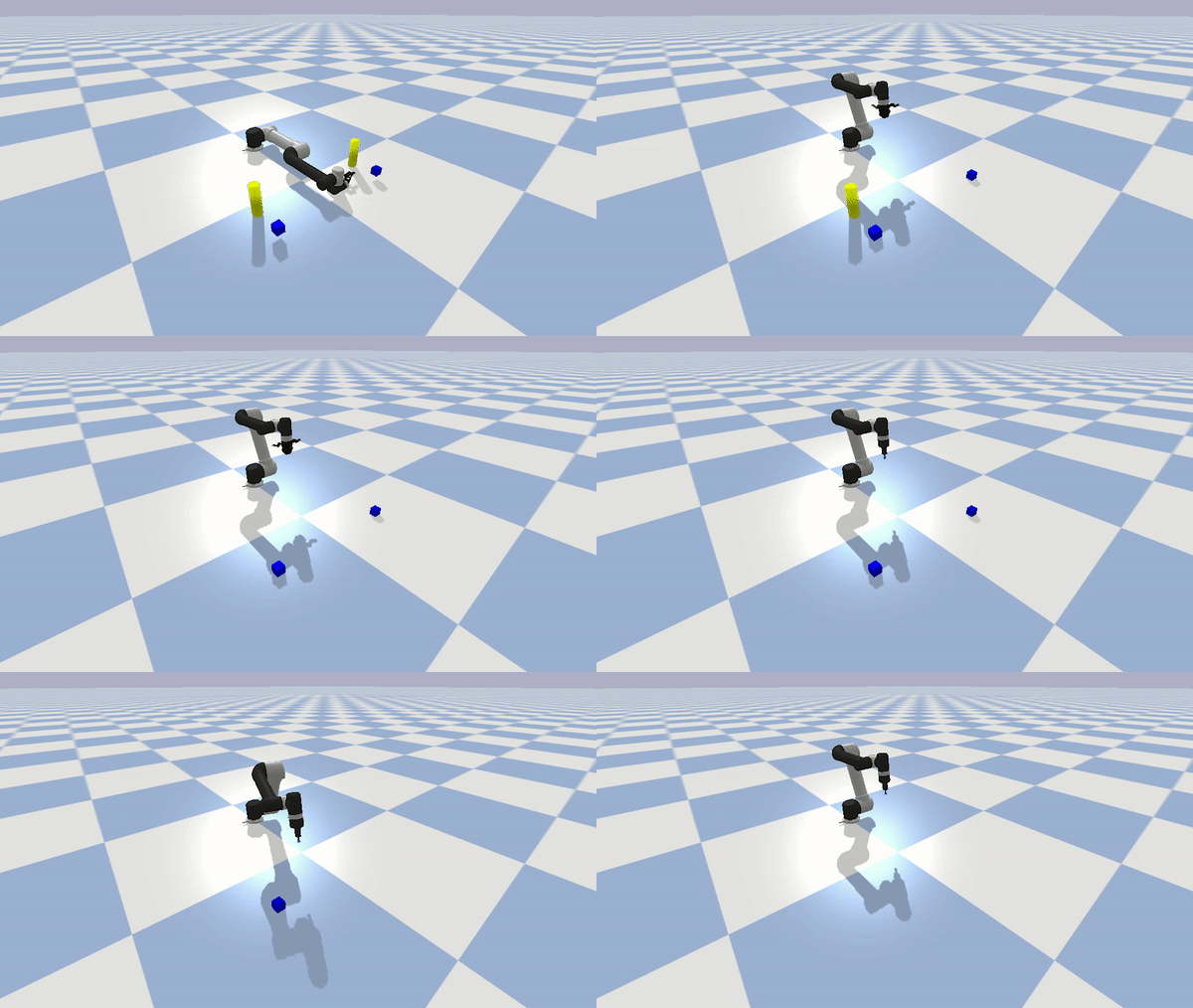
In this page,we show how dynamic reconfiguration works by changing the end-effectors.
1. Prerequisites
We assume a working installation of ManiWare and Pybullet is available (see the installation page), Moreover, we assume the reader to be familiar with the basic concepts of Pybullet, Python and ManiWare (see the quick start page).
2. Scenario illustration

3. Problem statement
Give a manipulator that equipped with joints, links, and end-effectors. We suppose to demonstrate the ability and evaluate the performance of dynamic reconfiguration, we design a scenario when the end-effector of a manipulator needs to be changed during the system running.
4. Implementation
When the manipulator requires a change, the component of the gripper-styled end-effector receives a interrupt command. The reconfiguration mechanism is triggered to keep the context of controllers, and the new controllers is loaded.
 def main():
     env = ReconfApp(robot_config=[{'Suction': 0}, {'Gripper': 1}], thing_config=[{'cube': 2}, {'cylinder': 2}])
     episode = 3
     for k in range(episode):
         obs = env.reset(cube_num=2, cylinder_num=2)

         # robot, T1, T2 = init(env.robots, env.available_thing_ids_set)
         scheduler = DynamicConfigureScheduler(env.robots, env.available_thing_ids_set)
         scheduler.robot.change_ee('Suction')
         start = time.time()
         step, done, R = 0, False, 0
         while not done:
             # time.sleep(100)
             # action = get_action(env.robots, obs[0], env.available_thing_ids_set, obs[1])
             if len(env.available_thing_ids_set) == 2 and scheduler.robot.action == 'idle' and scheduler.robot.rtype=='Suction':
                 scheduler.robot.ready = False
                 scheduler.robot.change_ee('Gripper')
             # T1, T2 = taskAs(robot, T1, T2)
             scheduler.allocate()
             obs, reward, done, info = env.step()
             R += reward
             sync(step, start, env.TIMESTEP)
             step += 1
     env.close()

if __name__ == "__main__":
   main()
5. Video demo
The video demo of this case study is shown as below.
Besides, you can find the whole video from Here